
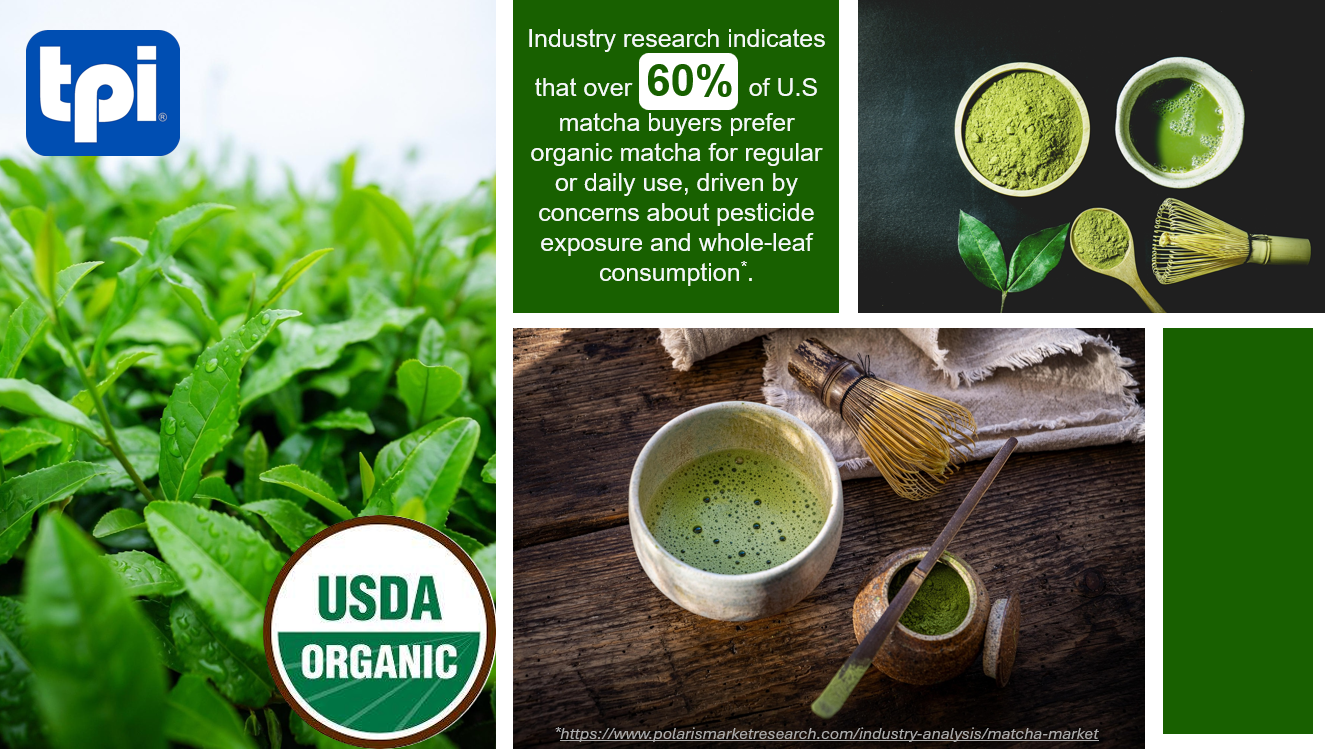
Organic Matcha Green Tea Powder is no longer a niche ingredient reserved for specialty cafés; it is a category leader in the global food and beverage landscape. As consumers increasingly demand clean-label and sustainably sourced products, organic matcha has emerged as the clear choice for brands seeking premium positioning.
As brands and manufacturers seek ingredients that deliver both wellness benefits and premium positioning, organic matcha has emerged as a clear category leader—commanding higher prices, stronger loyalty, and expanding adoption across retail, foodservice, and ready‑to‑drink applications.
Organic Matcha in the Context of a Rapidly Growing Matcha Market
The global matcha market continues to experience strong growth, driven by rising interest in functional beverages, plant‑based nutrition, and minimally processed ingredients. Market analyses consistently identify clean‑label and natural ingredient demand as among the most significant drivers of this expansion.
While many industry reports segment matcha by grade or end use, organic matcha repeatedly stands out as a high‑growth subsegment. Industry analysts note that organic certification plays a particularly influential role in North American and European purchasing decisions, where consumers express heightened concern about pesticide residues and agricultural transparency—especially for products like matcha where the whole tea leaf is consumed rather than steeped and discarded.
Grand View Research and Polaris Market Research both cite rising demand for organic and natural ingredients as a core factor accelerating matcha adoption, reinforcing that Organic Matcha Green Tea is not a niche within the category, but a premium expression of its fastest‑growing segment. [grandviewr…search.com], [polarismar…search.com]
Why Organic Matcha is Leading Market Growth
The global matcha market is projected to reach $5.40 billion in 2026. This growth is driven by several key factors:
-
Health and Transparency: In North America and Europe, organic certification is a primary driver for consumers concerned about pesticide residues.
-
Whole-Leaf Nutrition: Because matcha involves consuming the entire leaf, it provides higher concentrations of catechins, chlorophyll, and L-theanine than steeped tea.
-
Premiumization: Consumers show high pricing resilience for certified organic matcha, especially when paired with Japanese origin transparency.
Innovation in Clean-Label Applications
Organic matcha aligns exceptionally well with broader clean‑label and sugar‑reduction trends reshaping beverage and functional food development. As consumers scrutinize ingredient lists, organic matcha offers a naturally vibrant color, functional benefits, and flavor complexity without artificial additives.
This has made organic matcha especially attractive in plant‑based beverages, dairy‑free lattes, smoothies, and ready‑to‑drink formats—categories that already over‑index with wellness‑focused consumers. Industry analyses show sustained growth in organic matcha powders, latte blends, and RTD beverages as brands position matcha alongside other certified organic superfoods such as turmeric, spirulina, and cacao. [marketgrow…eports.com], [tastewise.io]
Organic matcha aligns with the shift toward sugar reduction and natural functional benefits. It is now a foundational ingredient in:
-
Ready-to-Drink (RTD) beverages and dairy-free lattes.
-
Functional Superfoods paired with turmeric, spirulina, or cacao.
-
Foodservice Menus, where “organic” is specified to signal quality to high-intent customers.
Key Insight: Organic matcha is a defensible point of differentiation for brands at the intersection of nutrition, sustainability, and consumer trust.
Premiumization and Pricing Power
One of the strongest indicators of organic matcha’s long‑term viability is its pricing resilience. Market researchers consistently report that consumers are willing to pay a premium for certified organic matcha, particularly when organic claims are paired with clear origin transparency, such as Japanese cultivation, shade‑grown tencha, or single‑estate sourcing.
Foodservice and retail data frequently reference ceremonial grade and organic matcha together, reinforcing a consumer perception that organic equals higher quality, authenticity, and craftsmanship. Even as supply constraints in Japan periodically affect organic matcha availability, price increases have not significantly dampened demand—highlighting strong category loyalty and brand stickiness. [polarismar…search.com], [tastewise.io]
Foodservice, Retail, and Menu Trends
Foodservice analytics show that organic matcha is increasingly specified directly on menus rather than referenced generically as “matcha.” This is particularly prevalent among premium cafés, juice bars, and wellness‑oriented chains seeking to signal quality and transparency to high‑intent consumers.
Search and menu trend data reveal significant overlap between consumer interest in ceremonial matcha and organic matcha, suggesting that certification cues matter most at the point of purchase. In retail, organic matcha continues to gain shelf space as brands capitalize on premium packaging, functional positioning, and clean‑label storytelling to differentiate in an increasingly competitive category. [tastewise.io], [marketgrow…eports.com]
Conclusion: A High Growth, High Value Ingredient
The evidence is clear: Organic Matcha Green Tea represents one of the most compelling opportunities in today’s ingredient landscape. It benefits from accelerating global demand for health driven products, strong alignment with clean label values, premium price tolerance, and a loyal, repeat consumer base.
For brands and manufacturers like Thymly Products, organic matcha is more than a trending ingredient—it is a defensible point of differentiation at the intersection of nutrition, sustainability, and consumer trust.
References & Sources
- Grand View Research – Matcha Tea Market Analysis
https://www.grandviewresearch.com/industry-analysis/matcha-tea-market [grandviewr…search.com]
- Polaris Market Research – Matcha Market Report
https://www.polarismarketresearch.com/industry-analysis/matcha-market [polarismar…search.com]
- Kochman et al., Health Benefits and Chemical Composition of Matcha Green Tea, Molecules (2021)
https://pmc.ncbi.nlm.nih.gov/articles/PMC7796401/ [pmc.ncbi.nlm.nih.gov]
- Koláčková et al., Matcha Tea: Nutritional Composition and Antioxidant Activity, Springer (2020)
https://link.springer.com/article/10.1007/s11130-019-00777-z [link.springer.com]
- Verified Market Research – Matcha Market by Nature (Organic vs. Conventional)
https://www.verifiedmarketresearch.com/product/matcha-market/ [verifiedma…search.com]
- DataM Intelligence – Global Matcha Market Forecast
https://www.datamintelligence.com/research-report/matcha-market [datamintel…igence.com]
- Tastewise – Matcha Trends & Menu Analytics
https://tastewise.io/blog/matcha-trends [tastewise.io]