Optimize, Don’t Always Reformulate: How Supplier R&D Helps Commercial Bakeries Improve Performance
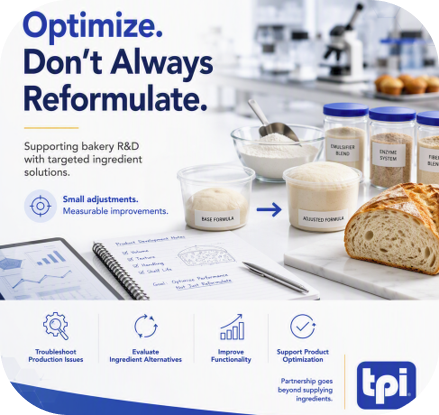
What is ingredient optimization in commercial baking? Ingredient optimization is the process of making strategic, targeted adjustments to an existing bakery formula rather than completely reformulating from scratch. By partnering with a bakery ingredient supplier’s Research & Development (R&D) team—such as the technical experts at Thymly Products—commercial bakeries can improve dough handling, extend shelf life, and maintain product consistency without the regulatory hurdles, high costs, and downtime of a complete overhaul.
The Hidden Opportunity Inside Existing Formulas
Many commercial bakery operations spend years refining products to achieve the ideal balance of texture, flavor, volume, shelf life, and processing performance. When challenges emerge—whether from ingredient variability, line inefficiencies, or changing production conditions—the thought of reformulating an established product can feel daunting.
Complete reformulation often requires:
-
Extensive testing and validation
-
Additional regulatory and label revisions
-
Customer approvals
-
Significant production adjustments
-
Increased development costs
Yet many performance issues can be addressed through targeted ingredient optimization. An experienced bakery ingredient supplier with dedicated R&D capabilities can evaluate current formulations and identify opportunities for improvement through precise, incremental adjustments. These changes deliver measurable results while preserving the core characteristics customers already know and trust.
Beyond Ingredients: Access to Specialized Expertise
Commercial bakeries face increasingly complex technical challenges. Ingredient functionality, dough handling characteristics, processing conditions, and clean-label initiatives all influence product performance. Few bakery teams have unlimited time or resources to investigate every issue internally.
Because ingredient manufacturers work across diverse product categories, they encounter similar challenges repeatedly and develop practical, scalable solutions. Instead of simply acting as a vendor, a collaborative bakery ingredient supplier R&D like Thymly Products functions as an extension of the bakery’s development team.
This R&D partnership provides access to:
-
Ingredient functionality expertise: Understanding how emulsifiers, enzymes, and custom blends interact.
-
Quality control: Leveraging SQF Level 2 certified facilities to ensure consistency and risk mitigation.
-
Pilot-scale evaluations and laboratory testing: Validating changes before they hit the production floor.
-
Technical troubleshooting support: Diagnosing issues with volume, texture, or machinability.
Troubleshooting Production Challenges Faster
Every wholesale bakery encounters production issues. Variations in flour quality, seasonal ingredient changes, environmental conditions, and equipment modifications can all affect finished product quality. These challenges often manifest as reduced volume, inconsistent texture, poor machinability, shortened shelf life, or increased waste.
When production issues occur, supplier R&D teams provide an objective technical evaluation. Rather than immediately recommending a new formula, they analyze ingredient interactions to improve performance while minimizing disruption.
A targeted optimization approach may involve:
-
Adjusting ingredient inclusion rates
-
Enhancing dough strength and moisture management
-
Extending freshness using clean-label alternatives, such as Thymly’s Natural Mold Inhibitor
-
Increasing processing tolerance
Working with a bakery ingredient supplier R&D team like Thymly we can focus improvements to help bakeries maintain product consistency while reducing downtime.
Evaluating Ingredient Alternatives with Confidence
Supply chain disruptions and cost pressures have made ingredient flexibility more important than ever. Commercial bakeries are frequently asked to evaluate alternative ingredients due to availability concerns or pricing fluctuations. However, replacing ingredients without understanding the functional impact can introduce unwanted risk.
Supplier R&D teams assist bakeries in assessing alternatives through controlled testing and technical analysis. Instead of trial-and-error experimentation on the production floor, bakeries can leverage supplier expertise to understand how ingredient changes affect texture, flavor profiles, shelf life, and finished product appearance.
Improving Functionality Without Compromising Quality
Consumer expectations continue to evolve, but quality remains non-negotiable. Whether the goal is improved softness, stronger dough tolerance, or better freeze-thaw stability, bakeries need solutions that support functionality.
Targeted ingredient technologies—including custom leavening systems, enzyme solutions, and functional ingredient blends—can deliver meaningful performance enhancements. The advantage of working closely with supplier R&D is the ability to pinpoint exactly where improvements can be achieved and select solutions that align with the bakery’s specific objectives. The focus shifts from changing everything to improving what already works.
A Partnership That Extends Beyond Supply
The most successful supplier relationships are built on more than transactions. Commercial bakeries benefit most when ingredient suppliers become active participants in product development and process optimization. A supplier with strong custom blending and R&D capabilities contributes knowledge, resources, and innovation that help customers remain competitive.
Because sometimes the smartest solution isn’t starting over. It’s optimizing what you already do best.
Frequently Asked Questions (FAQ)
What is the difference between reformulation and optimization in baking?
Reformulation involves completely rebuilding a bakery recipe, which requires extensive testing and new label approvals. Optimization involves making minor, targeted adjustments—such as tweaking an enzyme system or adding a dough conditioner—to solve a specific problem without changing the core recipe.
How does supplier R&D help commercial bakeries?
Bakery ingredient supplier R&D teams provide technical troubleshooting, custom formulation, ingredient functionality testing, and access to pilot-scale evaluations. They act as an extension of a bakery’s internal team to solve production issues faster and more cost-effectively.
Why is an SQF Level 2 certification important for bakery ingredient suppliers?
An SQF Level 2 certification ensures the supplier has a certified HACCP food safety plan in place. This guarantees rigorous monitoring of raw materials and manufacturing processes, minimizing risk and ensuring consistent quality for commercial bakeries.