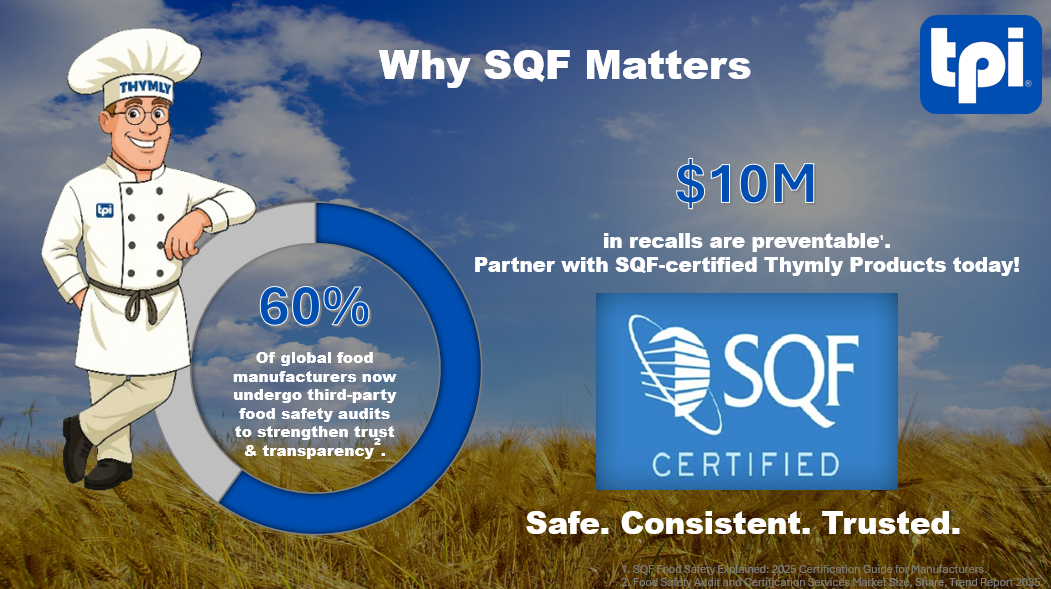
Food safety and quality are foundational to success in the food industry, especially for companies supplying functional ingredients to commercial bakeries. One of the most recognized ways to demonstrate a strong commitment to these principles is through the Safe Quality Food (SQF) Audit. While audits can be rigorous, they play a critical role in protecting consumers, strengthening operations, and reinforcing trust with customers.
Below, we break down what SQF is, why it matters, and how it supports long-term quality and consistency—along with how it aligns with our company’s values at Thymly Products.
-
What Is SQF and Why Is It Important?
The Safe Quality Food (SQF) Program is a globally recognized food safety and quality certification system that ensures food products are consistently produced and handled to the highest standards. Benchmarked by the Global Food Safety Initiative (GFSI), SQF focuses on preventing food safety risks through robust systems covering sourcing, sanitation, traceability, training, and documentation. Accredited third-party auditors verify that these systems are effectively implemented, followed, and continuously improved.
SQF is important because it:
- Helps protect consumers by reducing food safety risks
- Demonstrates compliance with regulatory and customer requirements
- Builds confidence with customers, retailers, and business partners
- Encourages a proactive, prevention-based approach to food safety
For many commercial bakeries and food manufacturers, SQF certification isn’t just preferred—it’s required. Achieving and maintaining certification signals that a company takes food safety seriously at every level of the organization.
-
The Impact of SQF on Quality and Consistency
Beyond compliance, the SQF Audit has a meaningful impact on overall product quality and operational consistency. The program emphasizes standardization, documentation, and repeatable processes—key drivers of reliable performance in food manufacturing.
From a quality standpoint, SQF requires clear controls around formulations, process parameters, allergen management, and corrective actions. This ensures that products meet defined specifications every time, reducing variability and minimizing the risk of defects or recalls. For functional ingredients used in commercial bakeries, this level of control is especially important, as consistency directly affects finished product performance.
From an operational perspective, SQF promotes:
- Clearly defined procedures and responsibilities
- Strong training programs and employee accountability
- Data-driven decision-making and continuous improvement
- Improved traceability and faster issue resolution
By embedding these practices into daily operations, businesses benefit from greater efficiency, fewer disruptions, and stronger alignment across teams. Over time, this becomes more than an audit—it becomes part of the culture, reinforcing the idea that quality and consistency are everyone’s responsibility.
-
Our Commitment to the Safe Quality Food Program
Successfully achieving SQF recertification for another year reflects our ongoing commitment to food safety, quality, and operational excellence. It’s a result of teamwork, preparation, and a shared focus on doing things the right way—every day.
While the audit itself happens once a year, the principles behind SQF guide our work year-round. Recertification is not just a milestone—it’s a reflection of the standards we hold ourselves to and the trust our customers place in us.